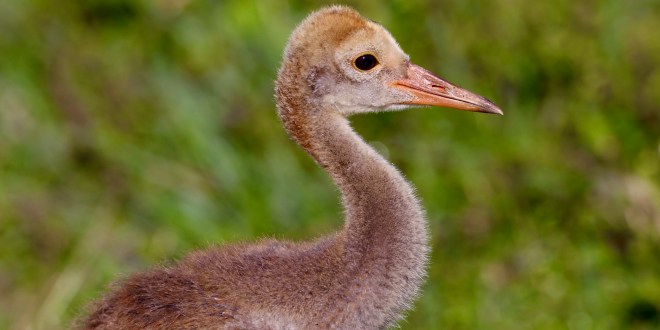

When I visited Orlando Wetlands a couple of months ago, the Sandhill Crane parents were busy sitting on a nest. And now look at how big their adorable colts are getting!!
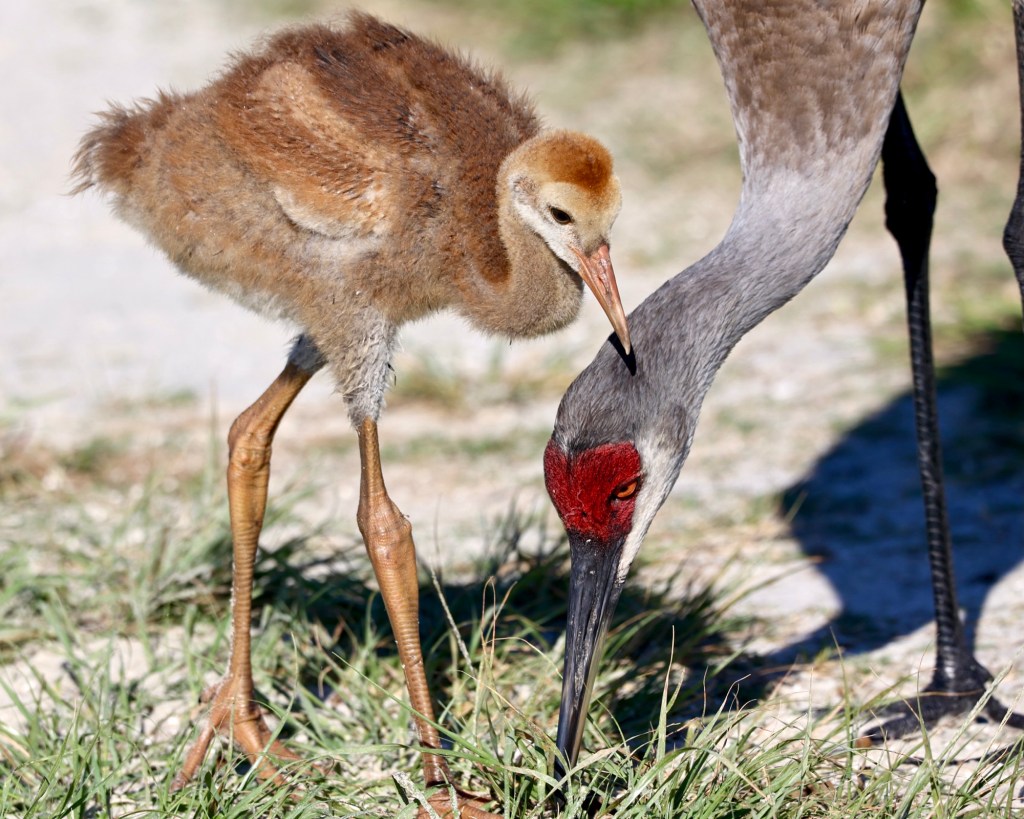
The little ones are amazingly mobile not long after hatching. “Their down dries 2 to 3 hours after hatching, by which time their eyes are open, they can sit up on their tibiotarsi, and sometimes even stand feebly.” (Birds of the World)

For the first week or two, the adults feed the hatchlings bill-to-bill, and the young become more and more independent as they grow (Birds of the World).

The Sandhill Crane’s “diet is heavy in seeds and cultivated grains, but may also include berries, tubers, small vertebrates, and invertebrates. Nonmigratory populations eat adult and larval insects, snails, reptiles, amphibians, nestling birds, small mammals, seeds, and berries.” (All About Birds-Sandhill Crane)

“Food items may be dropped at the feet of young by adults leading them to feeding opportunities.” (Birds of the World)
On this visit, I watched as both parents strolled along with these two youngsters, leading them to bits of food along the trail.

The Sandhill Crane is an omnivorous species and this 1650-acre expanse offers plenty to eat throughout its various wetland habitats.
Another interesting source of info is this Wildlife of Florida Sandhill Crane Fact Sheet.
 Birder's Journey
what a terrific and informative blog post. Thank you so much. It’s a very unique bird. One you can look at for a long time and watch their peculiar behavior and their unique walking style.
LikeLiked by 1 person
Thanks for your nice comments, Berny! I agree about what special birds the sandhill cranes are. We are so lucky to have them in our area, too.
LikeLike
How wonderful to see them this young!! I’ve never seen them this young. Thanks for sharing the video that was neat seeing that.
LikeLiked by 1 person
I’m so glad you enjoyed them, Deborah! Yes, it is always a special treat to see the little colts and watch them grow.
LikeLiked by 1 person
In Orlando’s Wetlands, not so remote, A birder’s tale begins to float. Sandhill Crane parents, of high repute, On a nest they sat, so astute. 🐦
Time whisked by, as nature’s clock ticked, Their colts, now big, in growth they picked. Just hatched, yet agile, a sight to adore, Mobility marvels, who could ask for more? 🌿
Their down, post-hatching, dries quite fast, In mere hours, a spectacle vast. Eyes wide open, on their legs, they perch, A feebly stand, in their lofty search. 🌤️
With bill-to-bill, the feeding dance, For weeks this lasts, in nurturing stance. Independence blooms, as they grow each day, In the wetland’s embrace, they find their way. 🌱
Seeds and grains, their diet’s main, Berries, tubers, a diverse terrain. Insects, snails, small prey caught in flight, An omnivorous diet, in their parents’ sight. 🐛
Food dropped at feet, a guide to feast, By adults, their care not in the least. Along the trail, a family stride, Leading the young, with food to coincide. 🍇
A 1650-acre wetland, a banquet vast, For the Sandhill Crane, their shadows cast. Omnivorous beings, in wetlands thrive, A birder’s journal, vividly alive. 📚
In Florida’s wild, a fact sheet sings, Of Sandhill Crane and the joy it brings. In this birder’s journey, tales unfold, A story of life, and wings so bold. 📖
LikeLiked by 1 person
Wonderful ode to Sandhill Cranes, Yishai, thank you. You’re so right – They are truly a spectacle!
LikeLike
We visited there in Orlando. You saw all of these Sandhill Cranes of the birds But we visited there in Orlando. Anita
LikeLiked by 1 person
Next time you’ll have to see the sandhill cranes!☺️
LikeLiked by 1 person
Wonderful to see the parents and their youngsters. Interesting background and beautiful photographs.
LikeLiked by 1 person
Thanks so much, Belinda! They are really fun to watch.
LikeLiked by 1 person
Beautiful captures BJ
LikeLiked by 1 person
I’m so glad you enjoyed them, AB!
LikeLiked by 1 person
Our sandhills are migratory — just passing through between summer breeding and winter feeding — so we don’t get to see the young. Thanks for sharing!
LikeLiked by 2 people
I’m happy you got to see these little guys, Amy!
LikeLike
Can’t get over these cranes!! 😭
LikeLiked by 1 person
I know, aren’t they cute?☺️
LikeLike
I had no idea people call a baby sandhill crane a colt. I wonder what the sandhill cranes themselves call their babies.
LikeLiked by 1 person
Probably Honey, CutiePie, and the like ☺️
LikeLike
You’ve created a really interesting documentary with illustrations on the life and times of Sandhill Crane colts.
We’re so lucky here in Florida to be able to see them at all stages of their development.
Thank you for sharing your trip to the wetlands park and its young residents.
LikeLiked by 1 person
Yes we are lucky. There is a pair near us at Loxahatchee NWR who had babies around the same time. But alas, we saw them a couple of times over the weekend and only one colt remains. 😞
LikeLike
How fantastic to see these young cranes with their attentive parents. They also are exquisite with their downy feathers. I also didn’t know they are called colts – very apt as so leggy!
LikeLiked by 1 person
Yes, the crane parents are really very protective and keep the colts close by for a long time. It still amazes me that they can walk on those tall spindly legs so soon after they come into the world ☺️.
LikeLiked by 1 person
The power of a pre-wired brain.
LikeLiked by 1 person
Absolutely amazing!
LikeLiked by 1 person
The young birds are so cute!
LikeLiked by 1 person
Agreed!! I love their tall legs!😉
LikeLiked by 1 person
They really are adorable with those long necks and legs and fluffy bodies, but please don’t tell their mom I doubt they’ll win the drug store’s baby photo competition… 😉
LikeLiked by 1 person
They get classier as they grow. 😉 I always think the adults look like baseball umpires with their red caps. ⚾️
LikeLiked by 1 person
What a wonderful set of photographs! These youngsters look amusingly gangly on their long legs – as if they’re on stilts. You’re very lucky to be able to watch them grow up. 🙂
LikeLiked by 1 person
Thank you so much, Ann! Yes, we are lucky!
LikeLiked by 1 person
Your photos and video are wonderful, thank you for giving us a little glimpse into the life of this family. Let’s hope the colts will grow up to live long and happy crane lives.
LikeLiked by 1 person
Yes, let’s hope. Though these parents are extra vigilant, it’s not uncommon to lose one of the colts to predation.
LikeLiked by 1 person
😦
LikeLike
What precious photos! I wish we lived close to each other. Imagine us exploring, together.
LikeLiked by 1 person
That would just delightful, Lorri☺️
LikeLiked by 1 person